Every spring and summer, I help direct a creative writing workshop at BYU called Young Authors’ Academy. When I first heard the name of the workshop, I thought that BYU Conferences and Workshops were being a bit presumptuous in calling these 14-17-year-olds “authors.” I get a new t-shirt at every workshop, and one of them has the word AUTHOR boldly displayed in a large font right on the chest. Whenever I wear it, I consider myself a pretender of sorts. In my mind, authors are the people on the New York Times bestseller lists. They are an elite group whose books are on the shelves of my classroom, the school library, and in Barnes and Noble bookstore.
Of course, that is faulty thinking. There are all kinds of writers, and most of them make very little, if any, money from it. A 2022 survey of 5,699 published authors by The Author’s Guild found that the median gross pre-tax income from their book sales was $2,000. I believe being a writer is largely a state of mind. Anyone who consistently puts pen to paper, or fingers to keyboard, is a writer. Of course, not all writers are equal. We are all in different stages of progression. However, most successful writers will admit to going through phases of very bad writing in creating something of value. Author Beth Revis sums up the process for many writers well: “I wrote a book. It sucked. I wrote nine more books. They sucked, too. Meanwhile, I read every single thing I could find on publishing and writing, went to conferences, joined professional organizations, hooked up with fellow writers in critique groups, and didn’t give up. Then I wrote one more book.” It’s the persistence that makes the writer.
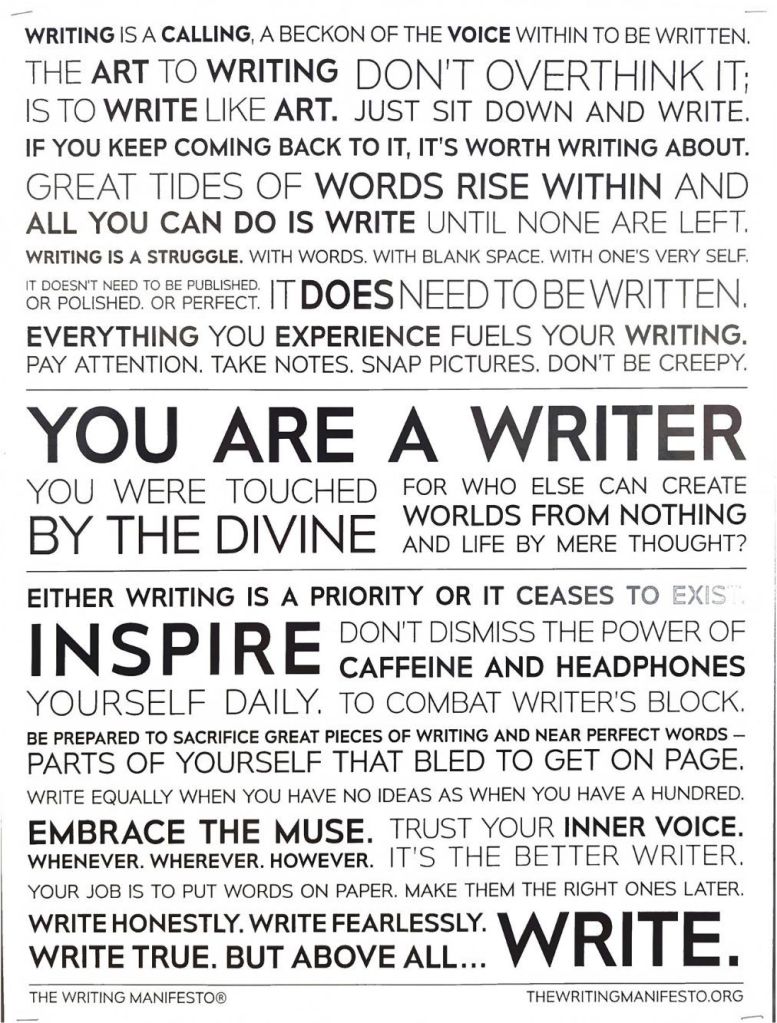
For decades, I have been a writer in hibernation. The first line of the Writer’s Manifesto, pictured above, says, “Writing is a calling, a beckon of the voice within to be written.” Even during dry spells, I have always had that voice. I have always believed that I had something inside me worth writing, but I have just lacked the confidence and discipline to write consistently. The only consistent writing I have been doing over the past decade has been on social media. Yes, I am one of those annoying people on social media who feels compelled to write about the injustices in the world and makes the occasional post celebrating the joy brought to me by the meaningful people in my life on birthdays, performances, and anniversaries. Social media writing is not satisfying. That is why this blog brings me so much joy. It allows me the opportunity to take a deep dive into topics that really matter to me. I’m hoping this will lead me to, once again, start submitting work for publication.
The first glimpse I had of my potential as a writer came in high school. Kay Woodward, my 10th-grade English teacher, was single, in her 30’s, and the cheer advisor. She was short, sturdy, with a head full of curly red hair. She had a boisterous personality and a contagious enthusiasm. Nothing was half-hearted with her. She taught sentence diagramming, literature, and Latin and Greek roots with passion, and she used that same passion responding to student writing with her red pencil. Every assignment I turned in was so full of red marks that I could hardly decipher the original text. I clearly didn’t have a mastery of the English language at the time, but I took no offense at her over-editing my work. She couldn’t help herself. However, those red marks were a sign to me that I was no writer.
My one glimpse of potential in that class came with an assignment to write a poem. It was my first attempt at writing poetry, and after multiple revisions, I ended up writing something playful to get the attention of the girls in the class. I remember saying something about any guy who found the right girl was someone who found a four-leaf clover and was as lucky as can be. The poem delighted Miss Woodward, and she read it aloud to the whole class. This was the first time in my life that someone recognized my writing. I really liked hearing my words out loud. And if the truth be told, I liked the attention. I was an introvert, and while a good student, I never felt that I was anything special in any academic sense. Yet, even the introverts like the spotlight on occasion.
The next year, my new teacher, Phyllis Bestor (the same Phyllis Bestor who inspired me to become a teacher and whose story I shared in an earlier post), called on us to write a memoir piece, a narrative about a significant life event. Because I could choose my own topic, my mind went to my recent experience at the state golf tournament. Golf was my passion as a teenager. I had vivid memories of being a freshman on the high school team and in competition with much older players. I remembered the butterflies of that day, the anticipation, the atmosphere, the accomplishments, and the disappointments. That morning, I walked up to the clubhouse at Bonneville Golf Course in Salt Lake and saw all of my competitors from high school teams throughout the state with their brightly colored bags and golf shirts. Boys were sinking putts on the practice green, and others were launching golf balls at the practice range. I felt so out of my league, but I also so badly wanted to make my high school and my family proud of me.
As I began drafting the text, I had a keen sense of my audience, and I wanted them to experience what I had experienced vicariously through my writing. For the first time in my life, I wrote multiple drafts of the same paper. I became familiar with the use of a thesaurus and discovered just how many synonyms were available to express myself. When I finished my final draft, I knew I had done my best work. It was a piece of writing a 16-year-old could be proud of. When Mrs. Bestor finished grading the papers, she passed them back to the class, but I did not get mine. The thought crossed my mind, with some dismay, that maybe she had lost it. Then, she said, “Class, I have a paper I want to share with you,” and she began reading my paper, my words, and I once again felt the thrill of hearing my words out loud and observing those words creating a connection with other people. I started to recognize that I had a gift, a way with words that others in my class did not. I wouldn’t have called myself a writer at that time, but I felt a new identity beginning to materialize.
Most of the writing that I did throughout the rest of my high school years was academic, and while I was good at it, it provided me little pleasure. After high school, I spent a year at BYU and found little opportunity to do the type of writing I wanted while I suffered through American Heritage, Biology, Physical Science, and the like. The summer after my freshman year, I left school to serve an LDS mission in Pennsylvania, and there I perfected my journal writing and letter writing skills. I thoroughly enjoyed my mission, particularly the opportunity to interact with so many people from different walks of life. When I returned from my mission and decided to be an English major, my writing focused on research and literary analysis, which I enjoyed to a certain degree.
However, what I really longed for was creative writing. In my junior year, I signed up for my first creative writing class. It was taught by a young professor named Chris Crowe. Dr. Crowe was charismatic, funny, and had the mischievous grin of an overgrown teenager. He also had a bizarre obsession with haiku, the Japanese poetic form. He later turned this obsession, I kid you not, into a novel about the Vietnam War written entirely in Haiku. It is a wonderful book titled Death Coming up the Hill, but that is another story. He first came to BYU on a football scholarship in the early days of the Lavell Edwards era, joined the church, did his graduate work at ASU, and had some short teaching stints in Japan and at BYU-Hawaii. His specialty was young adult literature.

Choosing Dr. Crowe as my creative writing instructor proved to be a fateful decision for me. One of the things I most appreciated about Dr. Crowe was his honest feedback. On Fridays, everyone in class would share something they were working on out loud, and he didn’t pull any punches with his feedback. I still remember him telling me that a poem I had written “needs to sound more like a poem” and a comedic scene I had written “simply wasn’t funny.” Yet he always balanced his criticism with encouragement. I learned that if I was going to be a writer, I needed to have thick skin. Constructive feedback wasn’t personal. It was the way to improve my craft. I would turn to Dr. Crowe often in future years for mentoring in both writing and teaching.
It was also cool being taught by a bona fide writer. Just before the beginning of our class, Dr. Crowe had written a young adult historical novel about a young African-American boy named Emmett Till, who was murdered and proved a major catalyst in the civil rights movement. It had been accepted by a major publisher. He even asked the class for title suggestions. The publisher decided on the title Mississippi Trial, 1955, and the book later received many awards.
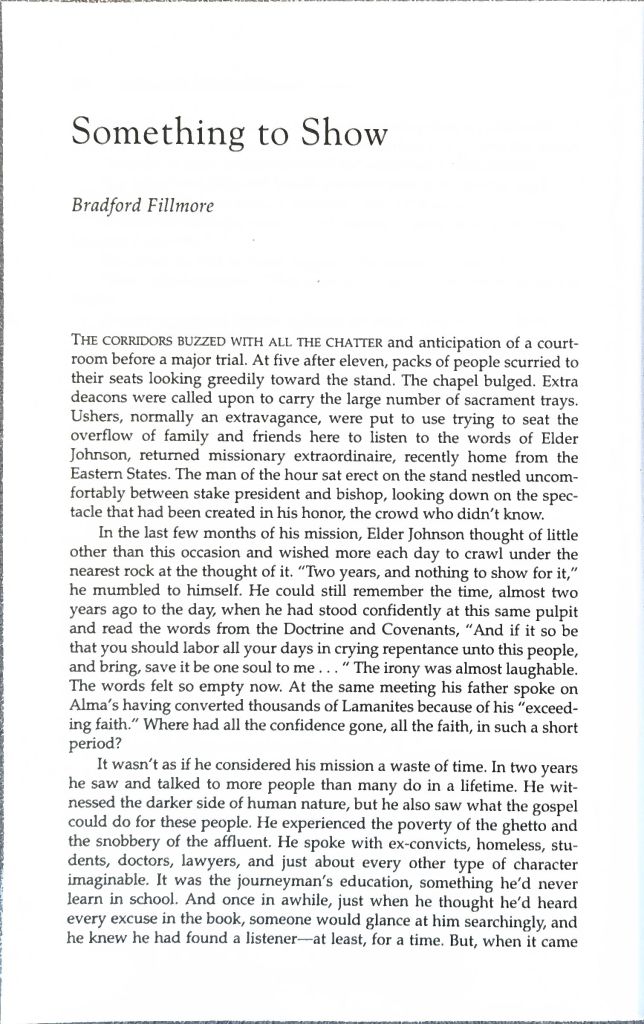
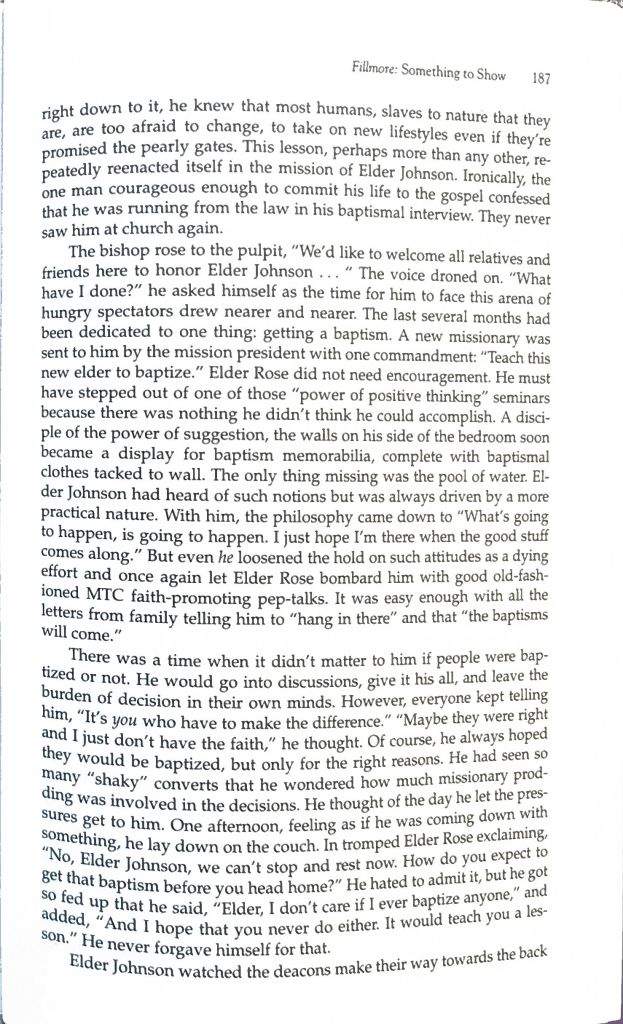
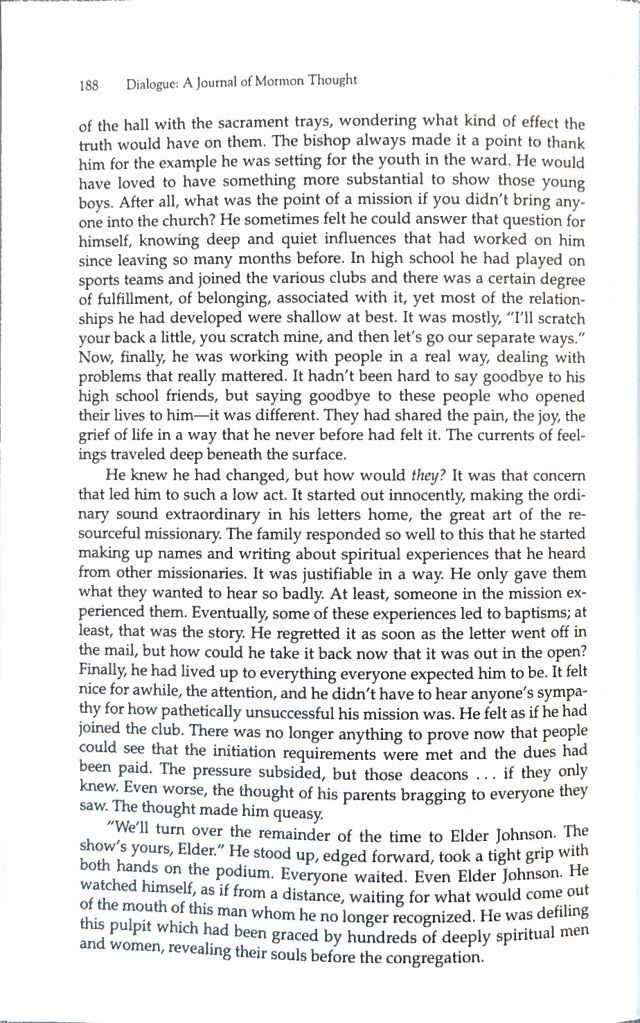
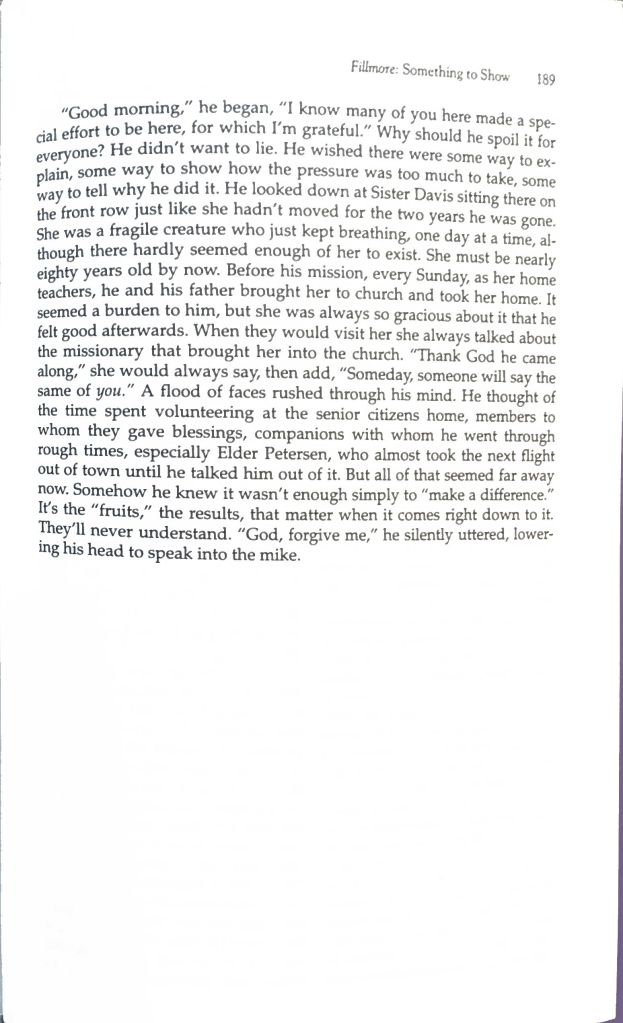
The class syllabus required all of us to write something in each of the creative writing genres: fiction, drama, and poetry. I decided to start by writing a short story, but I was clueless about where to begin. My mind started playing inferiority tricks on me again, and I became discouraged as I compared myself to Joyce, Hemingway, Bradbury, O’Connor, and the like. It was the night before the deadline, and in an act of either inspiration or desperation, I decided to write about a young LDS missionary. I decided to take the advice of Ernest Hemingway and to “write what you know.” Having just served a mission in Pennsylvania, I knew all of the ins and outs of missionary work. I knew the joys, the sorrows, and the intense desire to be successful and bring converts into the church. I started by asking a “what if” question. This was the question: What if a missionary felt so much pressure to be successful that he started to tell lies to the people back home about his great “successes”? I set the story at the young Elder’s homecoming sacrament meeting. The dramatic question of the story was “would the young man face his demons, or let the charade continue?” Once I got started, the story really wrote itself.
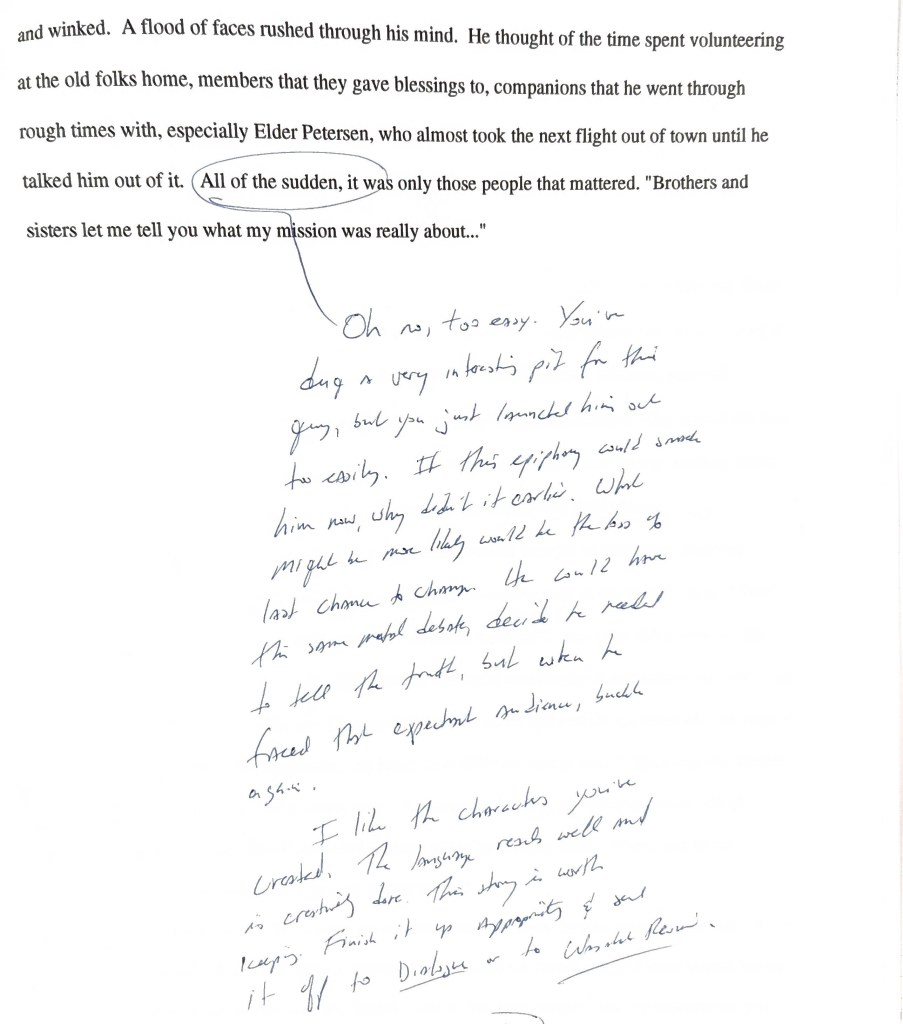
Dr. Crowe liked the story but called me out on the ending: “Oh no, too easy. You’ve dug a very interesting pit for this guy, but you just launched him out too easily. If this epiphany could smack him now, why didn’t it earlier? What might really be more likely would be the loss of last chance to change. He could have the same mental debate, decide he needed to tell the truth, but when he faced the expectant audience, buckle again. I like the characters you’ve created. The language reads well and is creatively done. This story is worth keeping . Finish it up and send it off to Dialogue or to Wasatch Review.“
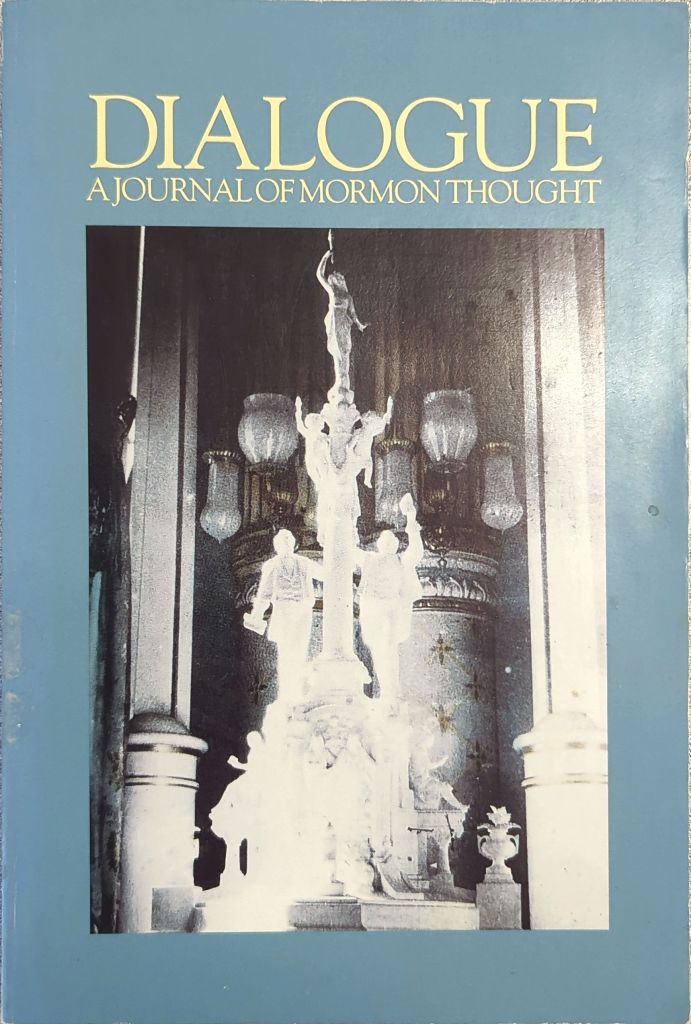
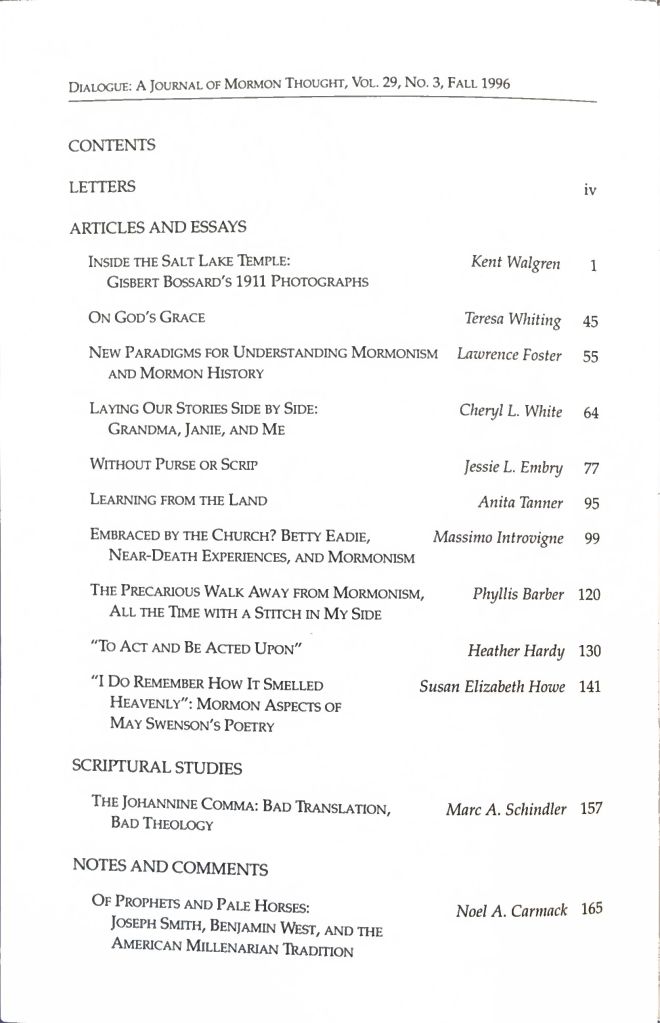
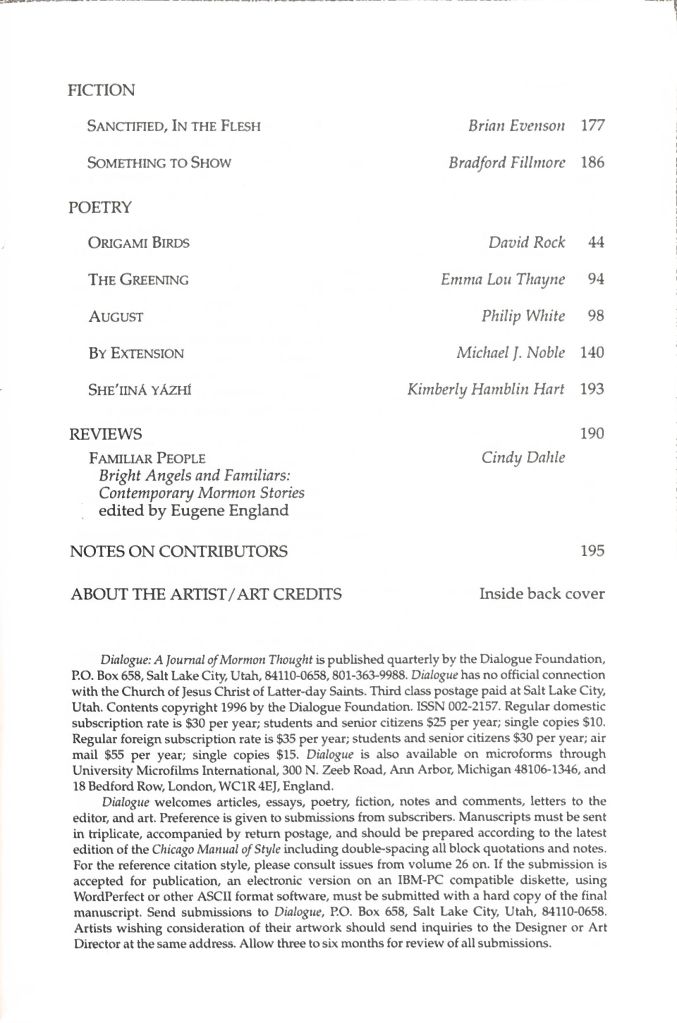
I knew he was right about the ending, but I was excited that he thought I had something publishable. I rewrote the ending and sent my story off, crossing my fingers that I could become a published writer for the first time. A few weeks later, I received a letter from the editor of Dialogue, saying he would like to publish my story. I felt like I was walking on air all day. I kept running the words through my mind, “Brad Fillmore, published writer.” Ideas for more stories started rolling through my brain. After a few months, the editor of Dialogue sent me several copies of the journal with MY STORY IN IT. I looked through the table of contents and found my story, “Something to Show,” by Bradford Fillmore. I decided to go with the longer version of my name. It sounded more authorial to me.
Though I was no James Joyce, I stood just a bit taller, raised my chin just a bit higher, and thrust my chest out just a bit further. I had proved to myself that, despite all of my doubts, I was indeed a writer.
P.S Dr. Crowe later told me that I had given him something in return. My getting published became one feather in his cap in his tenure application at BYU. After all he had done for me, I was very happy to hear that I could return the favor.


 My Song of Myself
Leave a comment